The honest answer
Is Puerto Rico safe?
Yes, for tourists who take normal precautions. Here is the whole picture, including the parts most guides leave out: the power grid, rip currents, and where petty theft actually happens.
Updated August 2026, sources checked liveThe short answer
Puerto Rico is safe for the overwhelming majority of visitors who stay in established tourist areas and use the same common sense they'd use in any major US city. There is no State Department travel advisory to check before this trip, because those advisories cover foreign destinations and Puerto Rico is US soil. That doesn't mean nothing to think about, it means the realistic risks are the ordinary ones: petty theft, rip currents at the wrong beach, and a power grid that's genuinely less reliable than the mainland's. All three are covered honestly below, neighborhood by neighborhood where it matters.
Why there is no advisory to check
A US territory, not a foreign country
Puerto Rico's legal status changes how the safety question even gets framed.
Puerto Rico is a US territory. Traveling there from the mainland is domestic US travel: no passport, no customs forms, no currency exchange, no immigration checks. That also means the State Department's travel advisory system, which describes risks for US citizens in foreign destinations, simply does not cover it. When we checked the advisory list live in August 2026, Puerto Rico did not appear on it at all, the same as Florida or Hawaii would not. So if a blog or an insurance pitch quotes a current "advisory level" for Puerto Rico, treat that as a sign the page has not been checked recently. The honest safety picture comes from what actually affects visitors on the ground, which is the rest of this page.
San Juan, area by area
Where visitors actually go
Most visitors spend most of their trip in four or five neighborhoods. Here is how they actually differ.
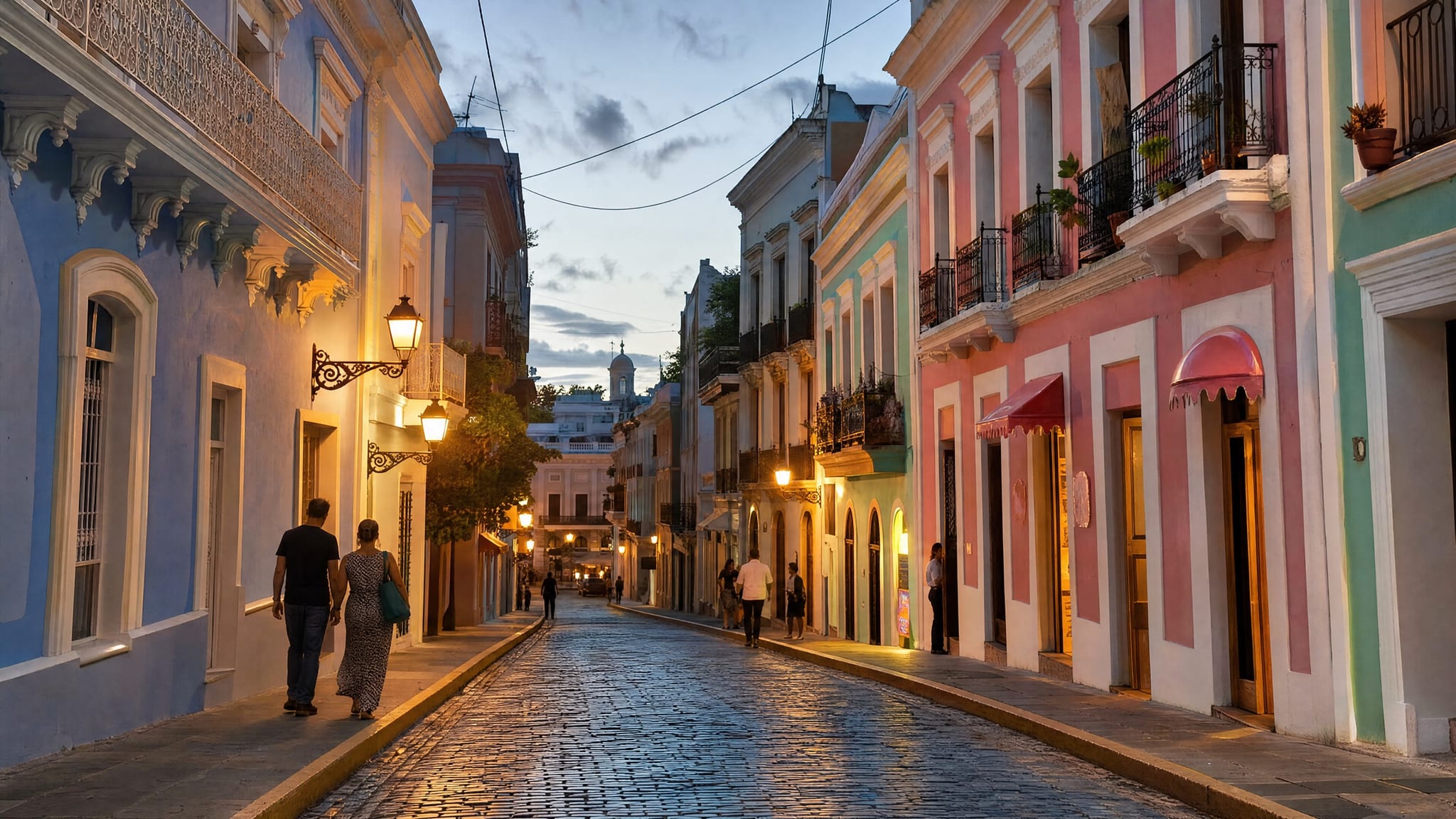
Old San Juan
The walled historic core: compact, heavily walked, and busy with visitors and police presence well into the evening. This is the lowest-friction part of the whole island for a first-time visitor. The blue cobblestones get slippery when wet, which is honestly the most common Old San Juan hazard. La Perla, the small oceanside neighborhood below the north wall, has opened up to visitors in recent years, especially around events, but it is a residential community, not an attraction; if you go, go in daylight, spend money politely at the businesses that welcome visitors, and skip it after dark.
Condado and Isla Verde
The two beach-hotel strips, Condado closer to Old San Juan, Isla Verde closer to the airport. Both are built around visitors: walkable, well-lit main avenues, restaurants open late, and the areas where the standard advice, watch your phone on the beach, do not leave bags unattended, is the whole story. The one block-level note: the side streets between the beach and the main avenue go quiet at night, so keep late-night walking to the lit main drags.
Santurce and La Placita
San Juan's arts-and-food district, and home of La Placita de Santurce, the produce market that turns into the city's best-known nightlife scene on weekend nights. It is a genuine local experience and broadly visitor-friendly, with the texture of a real working neighborhood: livelier blocks and quieter ones close together. Rideshare there and back at night rather than walking the in-between stretches, the same call you would make for a similar district in any US city.
The actual risk: petty theft
The most repeated real issue in local guidance isn't violent crime, it's pickpocketing in crowded tourist spots and break-ins at cars left visibly full of bags, electronics, or beach gear, especially at trailhead and beach parking lots outside the city. Never leave valuables visible in a parked car, take what matters to the beach in a small dry bag instead of leaving it in the trunk "just for an hour," and see our car rental guide for parking reality.
The realistic hazard
Beach safety and rip currents
More visitors are affected by open-ocean currents than by crime. This is the one to actually plan around.
Rip currents are a real, specific hazard on north- and west-facing, open-ocean, surf beaches, not a generic caution. Domes Beach in Rincon, for example, has a documented "toilet bowl" current pattern and a rocky bottom, experienced surfers and swimmers only. Sheltered, bay-shaped beaches like Sun Bay on Vieques and Seven Seas Beach in Fajardo are calmer, lifeguarded, and better suited to families and casual swimmers.
Two habits cover most of the risk. First, know what a rip looks like and how to escape one, swim parallel to shore, not against the current; the National Weather Service rip current guide is a two-minute read worth doing before a north-coast beach day. Second, check conditions before you swim: the NWS San Juan forecast office publishes surf and rip-current risk for the island's coasts, and lifeguarded balneario beaches post flag warnings. Our full beach guide carries swim-safety notes on every beach we cover, winter north-coast swells included.
The seasonal question
Hurricane season, framed honestly
The second-most-asked safety question after crime, and the one with the clearest honest answer.
Puerto Rico sits in the hurricane belt, and pretending otherwise would break every rule this site runs on. The Atlantic season runs June through November and peaks in September, which happens to be the island's quietest, cheapest stretch. Most fall trips pass without a storm anywhere near the island; the more common disruption is a heavy-rain event or a brush that cancels boat and bio bay tours for a day or two, not a direct hit.
The planning posture that actually works: book refundable rates for a September or October trip, consider trip insurance that covers weather interruption, keep an eye on the forecast inside ten days, and know that a storm that never comes costs you nothing. The full month-by-month picture, including what a watch or warning actually means for a visitor on the island, lives in our hurricane season guide.
The part most guides skip
The power grid, plainly
Not a crime issue in the traditional sense, but the thing most likely to actually disrupt a trip.
Puerto Rico's grid experienced an island-wide blackout in April 2025, cutting power to roughly 1.4 million customers before it was restored to about 99% within roughly 48 hours. More relevant day to day: per US Energy Information Administration data, Puerto Rico customers experience an average of about 27 hours of power interruptions per year, excluding hurricanes or other major events, versus roughly 2 hours per year for mainland US customers.
The honest, useful framing isn't "will there be an outage during my trip," which is unknowable, it's that outages happen here more often than mainland travelers are used to, and most hotels and resorts run backup generators for exactly that reason. Ask a specific property about its backup setup before booking rather than after. For what a storm season specifically adds on top of this baseline, see our hurricane season guide.
A couple more honest notes
Night driving and solo travel
Driving at night
Rural roads outside San Juan can be poorly lit, and signage is primarily in Spanish, both worth planning around rather than fearing. Stick to main routes after dark when possible, keep a phone with an offline map handy since cell service is unreliable in some rural and forested areas, and avoid rushing an unfamiliar mountain road at night if you can help it. Time the long cross-island drives, Ponce, Cabo Rojo, Rincon, to start and finish in daylight; the roads are fine, the visibility math is just better.
Traveling solo
Solo travel, including for women, is common in Puerto Rico's tourist areas, and this is one of the easier destinations in the Caribbean to do alone: it is domestic US travel, your phone works normally, 911 is the emergency number, and English is widely spoken in visitor areas. The same baseline precautions apply: stay in populated, well-lit areas after dark, share your plans with someone, take a rideshare instead of walking alone late at night, and book group tours for the remote stuff, the bio bays, El Yunque's interior, rather than going in alone.
Safety FAQ
Is Puerto Rico safe for tourists?
Yes, for tourists who stay in established tourist areas and take the same normal precautions they would in any major US city. Petty crime like pickpocketing and car break-ins happens, concentrated the way it would anywhere; violent crime rarely targets tourists who stick to well-trafficked areas. The realistic day-to-day hazards for visitors are car break-ins at beach and trailhead parking and rip currents at open-ocean beaches, not street crime.
What is Puerto Rico's State Department travel advisory level?
It does not have one, and that is the telling part. The State Department's travel advisory system rates foreign destinations, and Puerto Rico is a US territory, so travel there is domestic and no foreign-travel advisory applies. As of our live check in August 2026, Puerto Rico does not appear on the travel.state.gov advisory list at all. There is no advisory level to monitor before a trip, any more than there is for Florida.
Is it safe to walk in San Juan at night?
In the well-lit, active tourist areas of Old San Juan and Condado, walking at night is common and generally fine, especially where restaurants and bars keep the streets busy. Use the same judgment you would in any city: stick to populated, lit streets, keep an eye on your surroundings, and take a rideshare or taxi rather than walking through quieter or unfamiliar areas late at night.
Does Puerto Rico have power outages?
Yes, more often than mainland US travelers are used to. Per US Energy Information Administration data, Puerto Rico customers experience an average of about 27 hours of power interruptions per year, excluding hurricanes and other major events, versus roughly 2 hours per year on the mainland. Most hotels and resorts run backup generators specifically because of this.
What is the most common safety issue for visitors in Puerto Rico?
Petty theft, specifically car break-ins at trailheads, beach parking lots, and other spots where a car sits unattended, comes up repeatedly in local guidance as the most common real issue. Never leave visible bags, electronics, or valuables in a parked car. Rip currents at open-ocean, surf-facing beaches are the other realistic hazard, more relevant day to day than crime for most visitors.
Is it safe to travel solo in Puerto Rico?
Solo travel, including for women, is common and generally treated as safe within the standard tourist-area precautions: staying in populated areas, sharing your plans with someone, and using a rideshare after dark rather than walking alone through unfamiliar streets. The practical solo advantages here are real, too: it is domestic US travel, your phone works, and no language barrier blocks getting help, since English is widely spoken in tourist areas.
Is Puerto Rico safe during hurricane season?
Hurricane season runs June through November with a September peak, and most of it passes without a storm anywhere near the island. The honest framing is planning, not fear: book refundable where you can, consider travel insurance for a fall trip, and know that direct hits are rare while brushes and heavy-rain events are the more common disruption. Our hurricane season guide covers the month-by-month reality.
Ready to plan the actual trip?
Tell us who's coming and what you want out of the trip, and we'll map days that keep you in the areas that make the most sense.
Plan my Puerto Rico tripEvery fact on this page is sourced and dated.