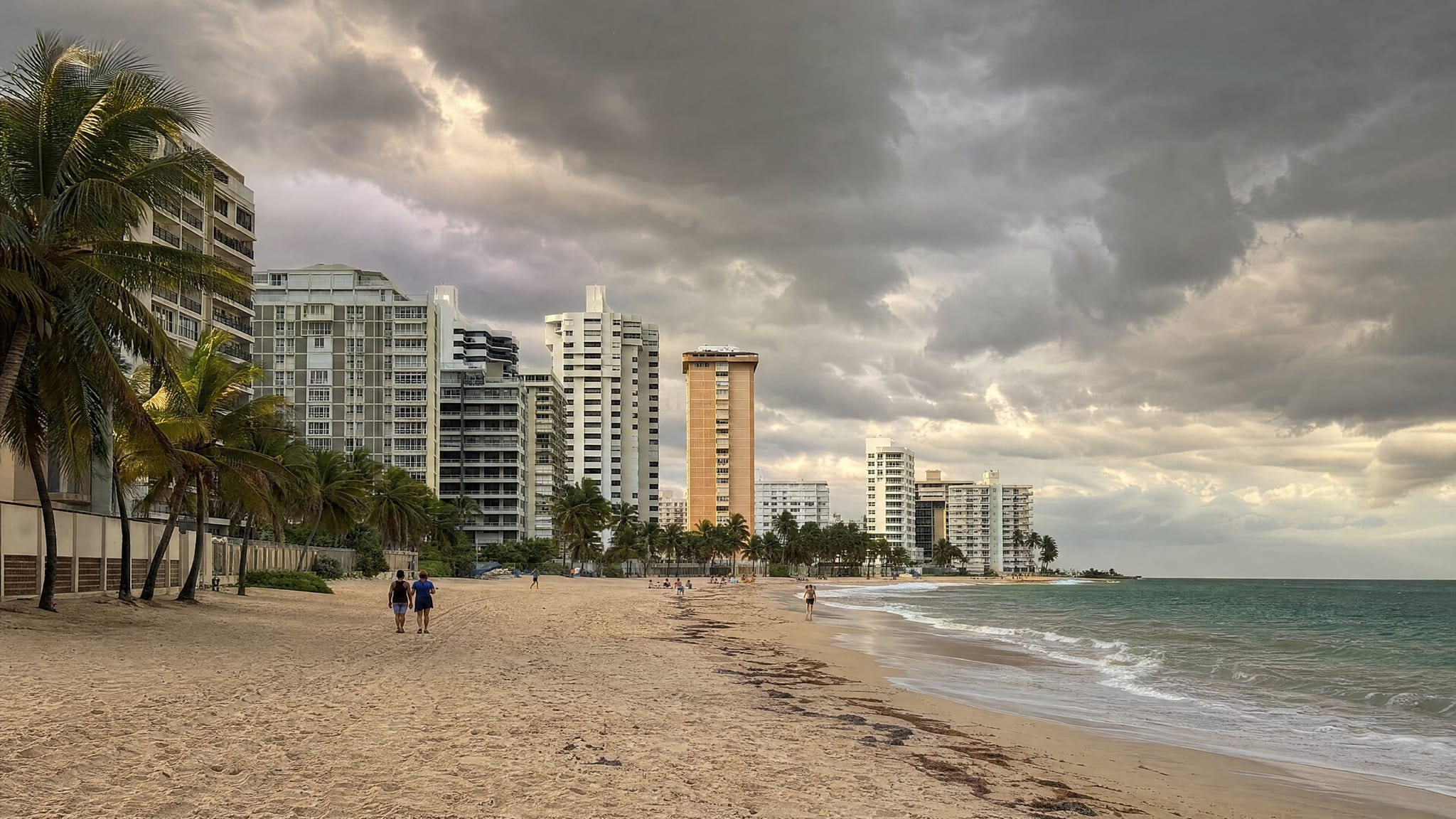
Hurricane season, honestly
Should hurricane season change your Puerto Rico trip?
June 1 through November 30, peaking in September. Here is NOAA's actual 2026 outlook, what a storm week really means for a visitor, and the honest picture on the power grid, not the vague version.
Updated August 29, 2026, NOAA and NHC checked liveThe season at a glance
Hurricane season, by the numbers
Real dates, the real 2026 forecast, and where your travel dates actually land relative to it.
June 1 to November 30
The formal Atlantic hurricane season window. September is historically the peak month for activity across the Caribbean.
NOAA's 2026 call: below-normal
In its August 6, 2026 update, NOAA gives a 75% chance of a below-normal season, 20% near-normal and 5% above-normal, calling for 7 to 13 named storms, 2 to 6 hurricanes and 0 to 2 major hurricanes. That is revised down from the May version, and it cites El Nino, which historically suppresses Atlantic activity.
Peak tourist season is storm-free
December through April, Puerto Rico's dry season and highest-visitor window, sits entirely outside the June to November hurricane season.
The 2026 season so far, as of August 29
The National Hurricane Center's 2026 advisory archive lists four named Atlantic storms to date: Arthur, Bertha, Cristobal and Dolly. All four are listed as tropical storms, meaning no Atlantic hurricane had formed yet, and no Atlantic system was active on the morning of August 29. When NOAA issued its updated outlook on August 6 the season had produced two named storms and accumulated cyclone energy sitting at 3% of the median for that point, which is why the agency cut its own numbers. Sources: nhc.noaa.gov/archive/2026 and cpc.ncep.noaa.gov/products/outlooks/hurricane.shtml.
Read that carefully, because it is easy to read it wrong. A quiet June through August says very little about September. NOAA expects most of the season's activity in the August to October window, and September is the historical peak; a below-normal season is a forecast about totals, not a promise about your specific week. The planning advice on this page does not change because the first three months were slow.
NOAA outlooks are revised through the season; confirm the latest update at cpc.ncep.noaa.gov/products/outlooks/hurricane.shtml before finalizing plans if you are traveling June through November.
If a storm does form
What a storm week really looks like
Most hurricane-season weeks pass without incident. Here is what actually happens on the ground during the ones that don't.
Flight waivers
Airlines typically issue fee-free rebooking waivers once a storm track threatens San Juan, so you can shift your flight without a change fee. Watch your airline's advisory page directly rather than assuming.
Ferry suspensions
The Culebra and Vieques ferries suspend service as conditions worsen and resume once safe. If a bio bay or beach day trip is booked during peak season, keep it loosely scheduled rather than locked to one date.
Resort generator reality
Most hotels and resorts run backup generators, which is exactly why the power grid section below matters: outages happen with or without a named storm, and properties plan around it.
The honest picture
The power grid, plainly
This is a real, ongoing fact about the island, not a scare story tied to any one storm.
Puerto Rico's grid experienced an island-wide blackout in April 2025, cutting power to roughly 1.4 million customers, restored to about 99% within roughly 48 hours. That single event isn't the real story for a visitor, though: per US Energy Information Administration data, Puerto Rico customers experience an average of about 27 hours of power interruptions per year, not counting hurricanes or other major events, versus roughly 2 hours per year for mainland US customers on average.
What that means practically: outages happen here more often than travelers from the mainland are used to, unrelated to whether a storm is anywhere nearby. Most hotels and resorts run backup generators specifically because of this, and it's a reasonable question to ask a property directly, how long can your generator run, and does it cover guest rooms or just common areas, before you book rather than after.
Worth sorting before you fly
Insurance and the named-storm rule
The one piece of paperwork that actually has a deadline tied to the weather.
Travel insurance that covers named-storm cancellations and interruptions only applies if the policy was bought before the National Hurricane Center actually names the storm, generally at least 24 hours before. Buy it once you book, not once a storm is already on the forecast, that's usually too late for the hurricane-specific coverage to kick in. Coverage details and deadlines vary by provider; read the actual policy before you rely on it.
Our travel insurance guide for Puerto Rico works through what a US territory changes about medical cover, how the named-storm cutoff is worded by the insurers themselves, and the trips where we would skip it.
See the insurance option we useHurricane Season FAQ
When is hurricane season in Puerto Rico?
The Atlantic hurricane season runs June 1 through November 30 every year, with activity typically peaking in September. Puerto Rico's dry season and peak tourist window, December through April, sits entirely outside that window.
What is NOAA's 2026 hurricane season outlook for the Atlantic?
NOAA updated the outlook on August 6, 2026 and revised it downward. The Climate Prediction Center now gives a 75% chance of a below-normal season, a 20% chance of near-normal and a 5% chance of above-normal, and calls for 7 to 13 named storms, 2 to 6 hurricanes and 0 to 2 major hurricanes, against 1991 to 2020 averages of 14, 7 and 3. The May version was 8 to 14 named storms, 3 to 6 hurricanes and 1 to 3 major hurricanes. NOAA cites El Nino, noting that every Atlantic season coinciding with a strong El Nino since 1950 has been below normal. Outlooks get revised through the season, so check cpc.ncep.noaa.gov/products/outlooks/hurricane.shtml directly if you are traveling June through November.
Should I cancel a Puerto Rico trip during hurricane season?
Not automatically. Most weeks in hurricane season pass without a storm anywhere near Puerto Rico, and September through early November is also when flights are often cheapest. The honest tradeoff is real risk of disruption versus lower prices and thinner crowds, not a reason to avoid the island outright.
Does Puerto Rico still have frequent power outages?
Yes, independent of any single storm. Per US Energy Information Administration data, Puerto Rico customers experienced an average of about 27 hours of power interruptions per year excluding major events like hurricanes, versus roughly 2 hours per year for mainland US customers. Most hotels and resorts run backup generators for exactly this reason; it's worth asking your specific property about their backup setup before you book.
When should I buy travel insurance for hurricane coverage?
Before any storm affecting your trip is named. Travel insurance policies that cover named-storm cancellations and interruptions only apply if you bought the policy before the National Hurricane Center names the storm, typically at least 24 hours before. Buying insurance once a storm is already forecast and named is generally too late for that coverage to apply.
What happens to flights and ferries if a storm approaches Puerto Rico?
Airlines typically issue fee-free rebooking waivers once a storm track threatens San Juan, letting you shift your flight without a change fee. The Culebra and Vieques ferries suspend service as conditions worsen and resume once it's safe. Neither is guaranteed on any specific timeline, so build flexibility into plans made during peak season (June to November).
Want your dates checked against the season?
Tell us when you're thinking of going, and we'll tell you honestly where those dates sit relative to peak season, storm risk, and the best prices.
Plan my Puerto Rico tripEvery fact on this page is sourced and dated.