For a lot of first-time visitors, the flight is the part of a Puerto Rico trip they quietly overthink. It should not be. Because Puerto Rico is a US territory, getting here from the mainland is a domestic flight: no passport for US citizens, no customs line on arrival, no currency to change, and your US phone keeps working the moment you land. The only real decisions are which of the island's three airports to fly into, which nonstop routes exist from your home city, and when to book so you are not overpaying. This is the honest version of all three, and 2026 turns out to be a good year to be asking, because airlines added more nonstop service to San Juan than the island has seen in years.
Our local team keeps this site's destination guides, vacation cost breakdown, and car rental guide current, and the question we get before any of those is simply how to get here. Here is what actually matters.
Puerto Rico has three airports, and you almost certainly want the first one
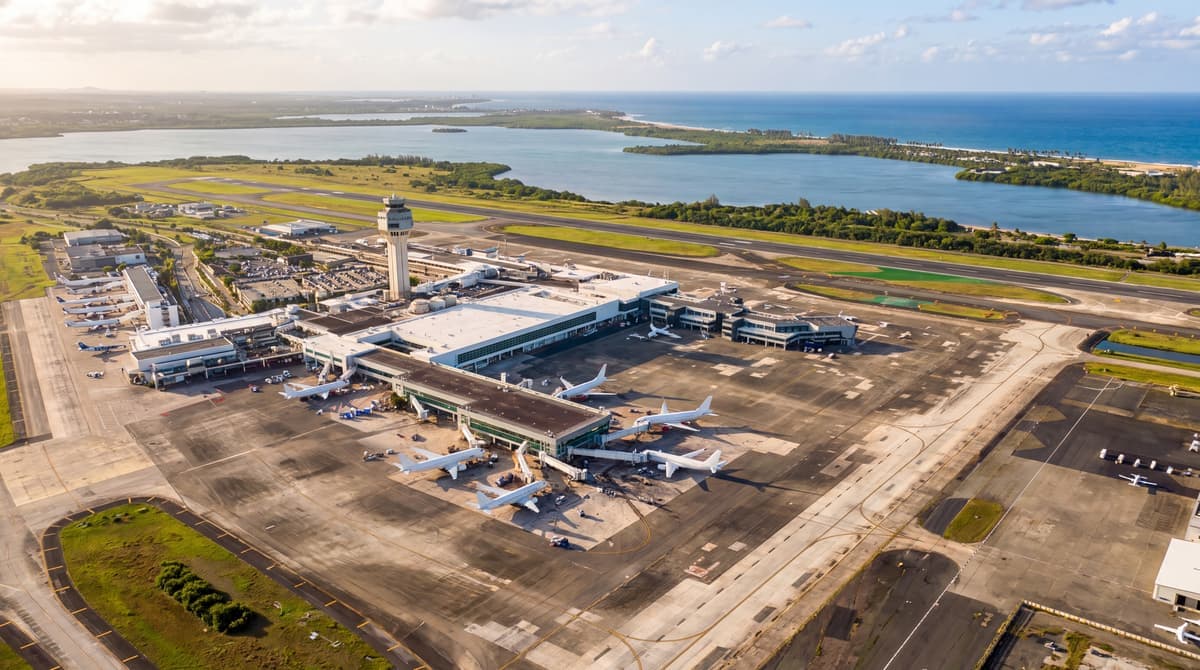
San Juan (SJU), Luis Munoz Marin International. In Carolina, just east of San Juan, this is the island's main gateway and the busiest airport in the Caribbean. It has by far the most nonstop routes from the mainland, the most airlines competing on price, and the widest choice of flight times, which is exactly why the large majority of visitors fly in and out of it. If you are basing in San Juan, staying near El Yunque, or heading to the Fajardo bio bays and the Vieques and Culebra ferries, SJU is the obvious and usually cheapest choice.
Aguadilla (BQN), Rafael Hernandez. On the northwest corner, this is the one worth knowing about. It sits about 15 miles from Rincon and roughly 80 miles from San Juan, so if your whole trip is the west coast, the surf towns, Isabela, or Cabo Rojo, flying into Aguadilla can save you the two-and-a-half-hour drive across the island each way. The honest caveat is that BQN has far fewer routes and airlines than San Juan, so the nonstop you want may not exist from your city, and fares can run higher precisely because there is less competition. Check both airports before you decide the drive is worth avoiding.
Ponce (PSE), Mercedita. On the south coast, this is a small third option with limited mainland service, mostly a handful of routes to cities like Orlando and New York. It is handy if you are headed specifically to Ponce or the south coast, and not in the running for most trips otherwise.
One planning note: you do not have to fly in and out of the same airport. An open-jaw itinerary, in through San Juan and out through Aguadilla or the reverse, lets you drive one direction across the island without doubling back. It usually costs a little more than a plain round trip, but for a west-coast-plus-San-Juan week it can be worth it.
Want your whole trip planned for you?
Tell us who is coming and when, and we will build your days around what you actually want.
It is a domestic flight, and that changes everything
This is the part that surprises people, so it is worth stating plainly: for US citizens, flying to Puerto Rico is a domestic flight. You board with the same ID you use for any US flight, which since May 2025 means a REAL ID-compliant driver's license or another TSA-accepted ID. There is no passport, no immigration booth, and no customs declaration when you arrive from the mainland. You pay in US dollars, your US phone plan works normally, and there is no international roaming to switch on.
The full detail, including what changes for non-US travelers (who need the same documents they would to enter the United States) and the one agricultural-inspection step on the way home, lives in our no-passport guide. For planning the flight itself, treat it as no different from flying to Florida.
What 2026 changed: more nonstop routes than ever
San Juan has long had nonstop flights from most major East Coast and Southern hubs, cities like New York, Newark, Boston, Philadelphia, Baltimore, Washington, Charlotte, Atlanta, Orlando, Miami, Fort Lauderdale, Tampa, Chicago, Dallas, and Houston, on the mix of carriers you would expect. What makes 2026 notable is how much that list grew. In March 2026, JetBlue added five brand-new nonstop routes to San Juan: a daily flight from Philadelphia, plus year-round service from Jacksonville, Norfolk, Richmond, and Buffalo, four cities that previously had no nonstop link to the island at all. That expansion brought JetBlue to 22 nonstop destinations from San Juan, more than any other carrier.
The practical upshot for a traveler is leverage. More seats and more competing airlines on a route generally mean more fare options and fewer forced connections, and several mid-size East Coast cities can now reach San Juan without changing planes for the first time. Two honest caveats come with it. First, the four new routes beyond Philadelphia run only a few days a week rather than daily, so if a flight on a low-frequency route gets cancelled, the next one may not be until the following day, which is worth weighing if you are flying from Richmond, Norfolk, Buffalo, or Jacksonville on a tight schedule. Second, airlines add and drop routes every season, so the only reliable way to know what flies nonstop from your city on your dates is to check current schedules rather than trust any fixed list, including this one.
Let us plan this trip for you
We check every spot against live sources, share your dates and we'll build the rest.
How long the flight actually takes
Puerto Rico is farther out than it looks on a map, but not by much. From the main Florida hubs, Miami and Orlando, a nonstop runs roughly three hours. From the New York area it is about three and a half to four hours nonstop, and Boston, Philadelphia, Baltimore, and Washington land in a similar range. From the middle of the country, think Chicago or Dallas, plan on four and a half hours or more, and from the West Coast you are almost always connecting, with a total travel day closer to eight or nine hours. These are approximate scheduled times, so confirm the exact block time on your own itinerary rather than planning a tight connection around a round number.
The free 7-day itinerary
The exact 7 days we send friends
One email with our day-by-day Puerto Rico plan: which beach on which day, where to eat, and the tours worth booking. No spam, unsubscribe anytime.
When flights are cheapest, and the honest catch
Airfare to San Juan follows the same rhythm as the rest of a Puerto Rico trip. The island's peak season runs December through April, dry, warm, and busy, and that is when flights and hotels cost the most. The winter holidays and the days around the San Sebastian Street Festival in late January are the very top of the market. The cheapest fares tend to fall in the off-peak stretch from roughly late April through early December, outside the holidays.
Here is the catch, stated honestly: that cheaper window overlaps hurricane season, which runs June 1 to November 30 and peaks in September and October. Late summer and early fall are genuinely the quietest and often cheapest time to fly, and NOAA's 2026 outlook actually leans below-normal, but a below-normal season is not a stormless one, and a single system can still disrupt travel. That is a real trade-off, not a free discount. If you are booking into that window, our hurricane-season guide covers how to weigh the timing and travel insurance, and the extra capacity from 2026's new routes gives fare-shoppers a little more room than usual. For the full month-by-month picture, see our best-time-to-visit guide, and for where the rest of the money goes once you land, the vacation cost breakdown and the budget guide.
Browse 30 vetted Puerto Rico experiences
Instant confirmation, free cancellation up to 24h.
After you land: the airport-to-anywhere reality
SJU sits in Carolina, right on the edge of the metro, so it is a genuinely short hop to where most people stay: about 10 to 15 minutes to Isla Verde and Condado, and roughly 20 to 30 minutes to Old San Juan depending on traffic. For a city-based trip you can skip a rental car entirely and lean on rideshare and taxis, which we cover in the where-to-stay guide. The moment El Yunque, the bio bays, Rincon, or the south and west coasts are on your list, a rental car stops being optional, and the tolls and paperwork of driving here are their own topic, laid out in the car rental guide. Aguadilla and Ponce are smaller and calmer on arrival, but they assume a car, because rideshare thins out quickly outside the metro.
How we would book it
For most first trips: fly in and out of San Juan, book the winter peak several months ahead and the off-peak far more casually, and only look hard at Aguadilla if your entire itinerary lives on the west coast. Check both a metasearch site and the airlines' own pages for your exact dates, because a route that did not exist last year may now be nonstop. Then remember that the flight is the easy part. Once your dates are set, the 7-day itinerary and the where-to-stay guide turn a plane ticket into an actual trip. The short version: it is a domestic flight to a Caribbean island, in dollars, with no passport, and in 2026 there are more ways to get here nonstop than there have been in years.
Find your hotel by area & budget
Compare current Puerto Rico rates across the major booking sites in one place, in USD. Most rooms are free to cancel.
FAQ
Do I need a passport to fly to Puerto Rico? No. For US citizens it is a domestic flight, so you board with a REAL ID-compliant driver's license or another TSA-accepted ID, with no passport, no immigration booth, and no customs when you arrive from the mainland. Non-US visitors need the same documents they would to enter the United States. See our no-passport guide for the full detail.
Which airport should I fly into in Puerto Rico? San Juan (SJU) for almost everyone: it is the main airport, with the most nonstop routes and usually the best fares, and it is central for the city, El Yunque, and the east-coast bio bays and ferries. Fly into Aguadilla (BQN) instead if your whole trip is the west coast, since it is about 15 miles from Rincon and saves the roughly 2.5-hour drive from San Juan. Ponce (PSE) is a small south-coast option with limited mainland service.
How long is the flight to Puerto Rico? Roughly three hours nonstop from Miami or Orlando, about three and a half to four hours from the New York area, and similar from Boston, Philadelphia, Baltimore, and Washington. From Chicago or Dallas plan on four and a half hours or more, and from the West Coast you are usually connecting, with a travel day closer to eight or nine hours. Confirm the exact time on your own itinerary.
When is the cheapest time to fly to Puerto Rico? Fares are highest in the December-through-April peak and around the winter holidays and the late-January San Sebastian festival. The cheapest fares usually fall in the off-peak stretch from about late April through early December, outside the holidays. The honest catch is that this window overlaps hurricane season, which peaks in September and October, so the savings come with a real trade-off.
Are there new direct flights to Puerto Rico in 2026? Yes. In March 2026 JetBlue added five new nonstop routes to San Juan: a daily Philadelphia flight plus year-round service from Jacksonville, Norfolk, Richmond, and Buffalo, cities that had no prior nonstop link. That brought JetBlue to 22 nonstop destinations from San Juan, more than any other carrier. Routes change every season, so always check current schedules for your dates.
Do I need a rental car after I land? For a San Juan city trip, no: rideshare and taxis cover the metro and its beaches, and SJU is only 10 to 15 minutes from Isla Verde and Condado. The moment El Yunque, the bio bays, Rincon, or the south and west coasts are on your plan, a rental car is the realistic way to get around, and Aguadilla and Ponce assume a car from the start.