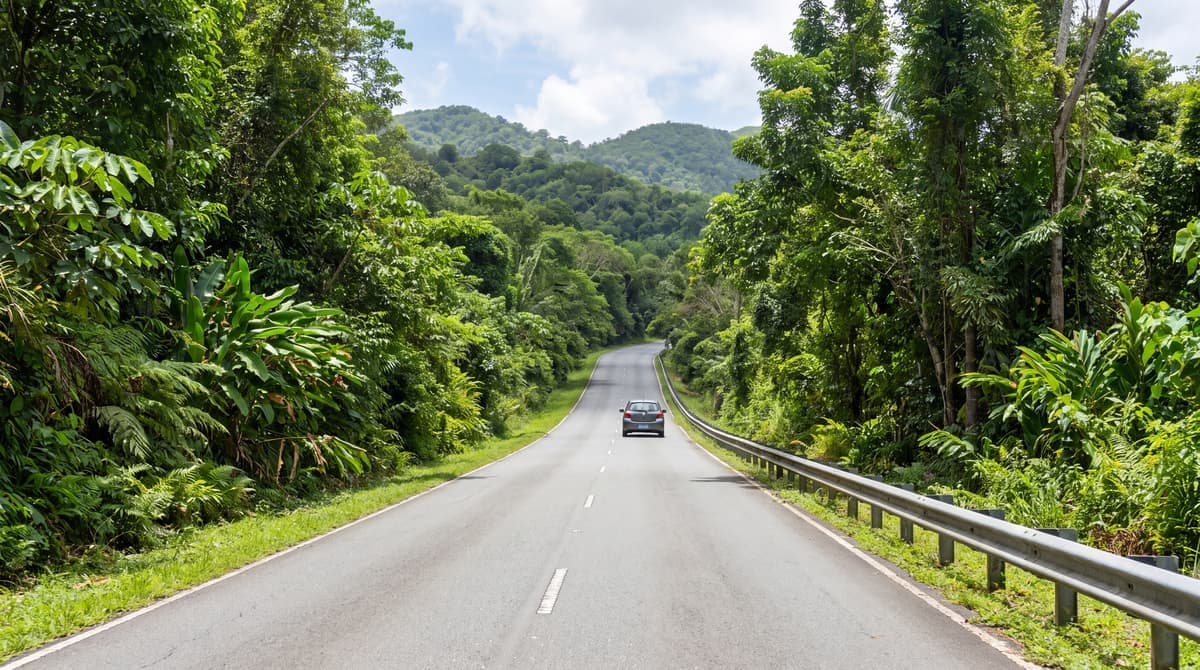
The question almost every first-time visitor quietly wrestles with is not where to stay or what to do. It is whether to rent a car. Get it wrong in one direction and you are paying for a car that sits in a hotel garage all week while you Uber everywhere anyway. Get it wrong in the other and you are stranded in a beach town at 6pm with no ride home. The honest answer is that it comes down to a single question about where your trip actually goes, and once you see it that way the decision gets easy. Here is how getting around Puerto Rico really works, from the metro to the far corners of the island.
Our local team keeps this site's destination guides, car rental guide, and 7-day itinerary current, and this is the question that comes right after you have booked the flight. One thing worth saying up front, because it quietly makes everything below easier: Puerto Rico is a US territory, so your US phone plan works normally with no roaming to switch on, which means the Uber app, Google Maps, and your hotel's texts all just work the moment you land, the same as they would in Florida.
The short version: it is one question, not a hundred
Strip away the noise and the whole decision rests on this: is your trip based in San Juan, or does it range out across the island?
If you are staying in the city for a long weekend, wandering Old San Juan, the Condado and Isla Verde beaches, and the restaurants in between, you do not need a car. Walking plus Uber plus the occasional taxi will cover you comfortably, and you will skip the tolls, the parking, and the daily rental fee entirely.
If your trip reaches El Yunque, the Fajardo bio bays, Ponce, Rincon, or the south and west coasts, you will want a rental car, because the easy ride options thin out fast the moment you leave the metro. A lot of trips are a mix of the two, and for those the right move is often to stay carless in the city and rent for only the day or two you head out. Everything below is just the detail behind that one question.
Renting a car? Compare every Puerto Rico agency
One search across the island rental companies, free cancellation on most cars, no card to reserve.
Uber in Puerto Rico: excellent in the metro, absent past it
Uber is the island's only major rideshare app. It launched here back in 2016, and despite occasional rumors, Lyft does not operate in Puerto Rico as of 2026, so Uber is the whole story. In the San Juan metro it is genuinely good: coverage across San Juan, Carolina, Bayamon, Guaynabo, Catano, and Trujillo Alto is reliable, wait times in populated areas usually run under about ten minutes, and fares for a hop across the city are cheap compared with a taxi.
Yes, you can take an Uber from the airport. Rideshare pickups at Luis Munoz Marin International (SJU) happen at designated spots on the ground floor of Terminals A and B, so you head to the marked rideshare zone rather than the taxi line. From there it is only a short ride to where most people stay.
Two honest caveats. First, coverage effectively stops at the edge of the metro. Request a ride from El Yunque, a Fajardo marina, Ponce, or a west-coast surf town and you may wait a very long time or get nothing at all, which is exactly how people end up stranded. Uber is a city tool, not an island one. Second, fares surge during rush hour, roughly 7 to 9am and 4 to 6pm, when a short trip that was a few dollars off-peak can climb sharply, so build a little patience into weekday mornings and evenings. A few San Juan hotels also steer arrivals toward their own taxi arrangement, so if that matters to you it is worth a quick question at check-in.
Taxis: the posted airport zone fares are the useful part
San Juan's tourist taxis are more predictable than most visitors expect, because the Puerto Rico Tourism Company sets fixed, posted flat fares between the airport, the cruise piers, and the main tourist zones. From SJU, plan on roughly $12 to Isla Verde, about $17 to Condado, Ocean Park, and Miramar, and about $21 to Old San Juan and the cruise ship piers. On top of the base fare there is a small airport surcharge, a per-bag charge of about a dollar, and different rates at night, so treat those numbers as the fare for the ride itself rather than the final total.
The honest caveats: these flat fares only apply within and between the defined tourism zones. Go anywhere outside them and the taxi runs on a meter instead, which starts around $1.75 plus roughly $1.90 a mile and adds up quickly over any distance. Fares are also posted at the airport taxi stand and do drift over time, so glance at the board and confirm the price before you get in. For a first arrival with luggage, though, a zone taxi straight to your hotel is simple, needs no app, and the price is not a surprise.
Want your whole trip planned for you?
Tell us who is coming and when, and we will build your days around what you actually want.
Publicos: the cheapest, most local, and slowest option
If you want the true local budget option, Puerto Rico has publicos, government-franchised shared cars and vans that run set routes between towns. They are cheap: short hops run roughly $3 to $5 a person, and a long haul like San Juan to Ponce is only about $15. Each town has a terminal, usually near the central plaza, where they gather.
The trade-offs are real, which is why most visitors never use them. A publico leaves when it is full rather than on a schedule, stops frequently along the way, and outside San Juan generally stops running by around 5 or 6pm. Drivers rarely speak English, so a little Spanish helps a lot, and the whole system rewards a relaxed traveler with time to spare, not anyone on a tight plan. Think of publicos as a genuinely local, low-cost way to move between towns in daylight, not as a way to build a day around specific sights.
The free 7-day itinerary
The exact 7 days we send friends
One email with our day-by-day Puerto Rico plan: which beach on which day, where to eat, and the tours worth booking. No spam, unsubscribe anytime.
When you should just rent a car
For everything beyond the metro, a rental car is the realistic answer, and often the only one. El Yunque has no public transport to the trailheads. The Fajardo and Vieques bio bays, the beaches of the east coast, Ponce and the south, and the surf and sunsets of the west coast around Rincon all assume you are driving yourself. Our day trips from San Juan guide is essentially a list of places that a car unlocks and Uber does not.
The middle path is worth repeating because it saves real money: if your trip is mostly city with one or two excursions, stay carless in San Juan and rent a car only for the days you actually leave town, or let a guided tour handle the driving. Booking a rainforest or bio-bay tour that includes hotel pickup means you never touch a steering wheel or a toll for that day, which for a lot of first trips is the least stressful way to see the island's headline sights.
One important exception: the islands of Culebra and Vieques. You do not drive your rental car out there. The passenger ferry runs from Ceiba on the east coast, and most rental companies will not let you take their cars across, so the move is to get to the ferry, cross as a foot passenger, and use golf-cart rentals, taxis, or publicos once you land. The logistics of that crossing have their own guide in our Culebra ferry writeup.
Let us plan this trip for you
We check every spot against live sources, share your dates and we'll build the rest.
Driving here: tolls, quirks, and the US-license question
If you do rent, driving in Puerto Rico is straightforward with a few local wrinkles worth knowing before you pull out of the lot.
Your license works. Because Puerto Rico is a US territory, a mainland US driver's license is valid here with nothing extra required, the same as the fact that you need no passport to visit. Visitors from other countries should carry an International Driving Permit alongside their home license.
Tolls are electronic and cashless. The island's toll system, AutoExpreso, works like E-ZPass, and several major highways, including PR-52, PR-22, PR-66, PR-20, PR-5, PR-53, and the Teodoro Moscoso Bridge, accept only the electronic transponder with no cash lanes at all. Most rental cars come with a transponder and pass the tolls through to your bill, sometimes with a daily service fee, but confirm your car has one when you pick it up, because rolling through a cashless toll without it can trigger a steep fine. Individual tolls themselves are small, roughly $0.35 to $5 depending on the road.
A few measurement quirks catch people out. Road distances on signs are posted in kilometers, but speed limits are in miles per hour, and gas is sold by the liter. None of it is difficult once you know, but it is genuinely disorienting for a first-timer who assumes everything is in miles. Beyond that, San Juan traffic is heavy and its street parking is tight, which is another argument for staying carless in the city and picking the car up only when you head out. The full detail on rental fees, insurance, and the driving experience lives in our car rental guide.
How we would decide
Put it all together and the call is usually clear. For a San Juan city break, skip the car: walk, use Uber in the metro, take a flat-fare zone taxi from the airport, and put the rental savings toward dinners and tours. For a trip built around El Yunque, the bio bays, Ponce, or the west coast, rent a car and plan for the tolls and the kilometer signs. For the common mix of both, stay carless in the city and either rent for the excursion days or book tours with pickup, which is often the cheapest and least stressful version of all. And for Culebra or Vieques, leave the car behind entirely and take the ferry. Match the transport to where your trip actually goes, and getting around Puerto Rico stops being the thing you overthink. If you want the whole plan in one place, our 7-day itinerary and where-to-stay guide build the trip around exactly these choices.
Browse 30 vetted Puerto Rico experiences
Instant confirmation, free cancellation up to 24h.
FAQ
Do you need a car in Puerto Rico? Only if your trip leaves the San Juan metro. For a city-based trip, walking plus Uber plus the occasional taxi covers you, and skipping the rental saves the daily fee, tolls, and parking. The moment El Yunque, the Fajardo bio bays, Ponce, or the west coast is on your plan, a rental car becomes the realistic way to get around.
Does Puerto Rico have Uber? Yes. Uber is the only major rideshare app on the island (there is no Lyft as of 2026), and it works well across the San Juan metro, including from designated pickup spots on the ground floor of Terminals A and B at the airport. Coverage effectively stops at the edge of the metro, so it is a city tool rather than an island-wide one.
How much is a taxi from San Juan airport? The Puerto Rico Tourism Company sets fixed zone fares from SJU: roughly $12 to Isla Verde, about $17 to Condado and Ocean Park, and about $21 to Old San Juan and the cruise piers, plus a small airport surcharge, a per-bag charge of about a dollar, and different night rates. Outside those tourism zones taxis run on a meter, which starts around $1.75 plus about $1.90 a mile. Fares are posted at the stand, so confirm before you ride.
What are publicos in Puerto Rico? Publicos are government-franchised shared cars and vans that run set routes between towns from terminals near each town plaza. They are very cheap, roughly $3 to $5 for short hops and about $15 from San Juan to Ponce, but they leave only when full, stop often, generally shut down by around 5 or 6pm outside San Juan, and rarely have English-speaking drivers. They suit budget travelers with time to spare more than anyone on a schedule.
Can I drive in Puerto Rico with a US license? Yes. Puerto Rico is a US territory, so a mainland US driver's license is valid with nothing extra needed. Visitors from other countries should carry an International Driving Permit with their home license. Just know that tolls are electronic and cashless on several major highways, road distances are in kilometers while speed limits are in miles per hour, and gas is sold by the liter.
Do I need a car for Culebra or Vieques? No, and you generally cannot take a rental car anyway. You reach both islands by passenger ferry from Ceiba on the east coast, cross as a foot passenger, and get around once there with golf-cart rentals, taxis, or publicos. Our Culebra ferry guide covers the crossing logistics.